Web dashboard
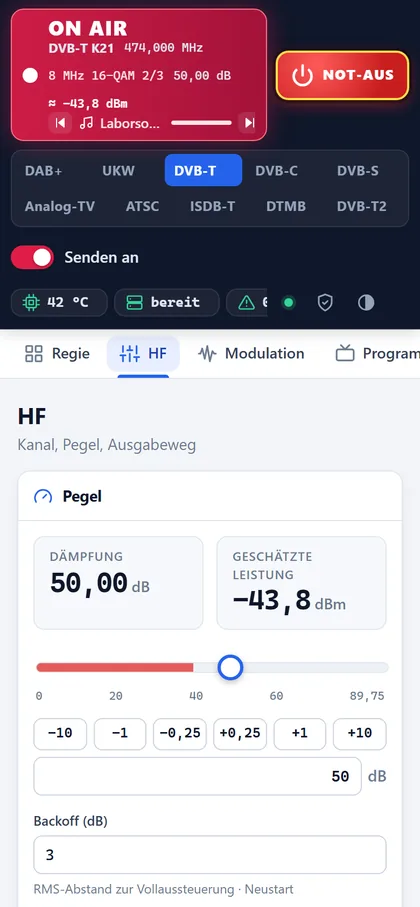
Runs in the browser, light and dark, also on a phone. Works offline, no cloud.
For the ADALM-Pluto (PlutoSDR)
Muxwright turns an ADALM-Pluto into a multi-standard lab transmitter. DAB+, FM with RDS, DVB-T/T2, DVB-C, DVB-S/S2, ATSC, ISDB-T, DTMB, PAL and NTSC from one interface, with an expected/actual report and a test record included.
Features by standard
Level, channel, monitoring, presets and records work the same for every standard. Only the standard-specific parameters change.
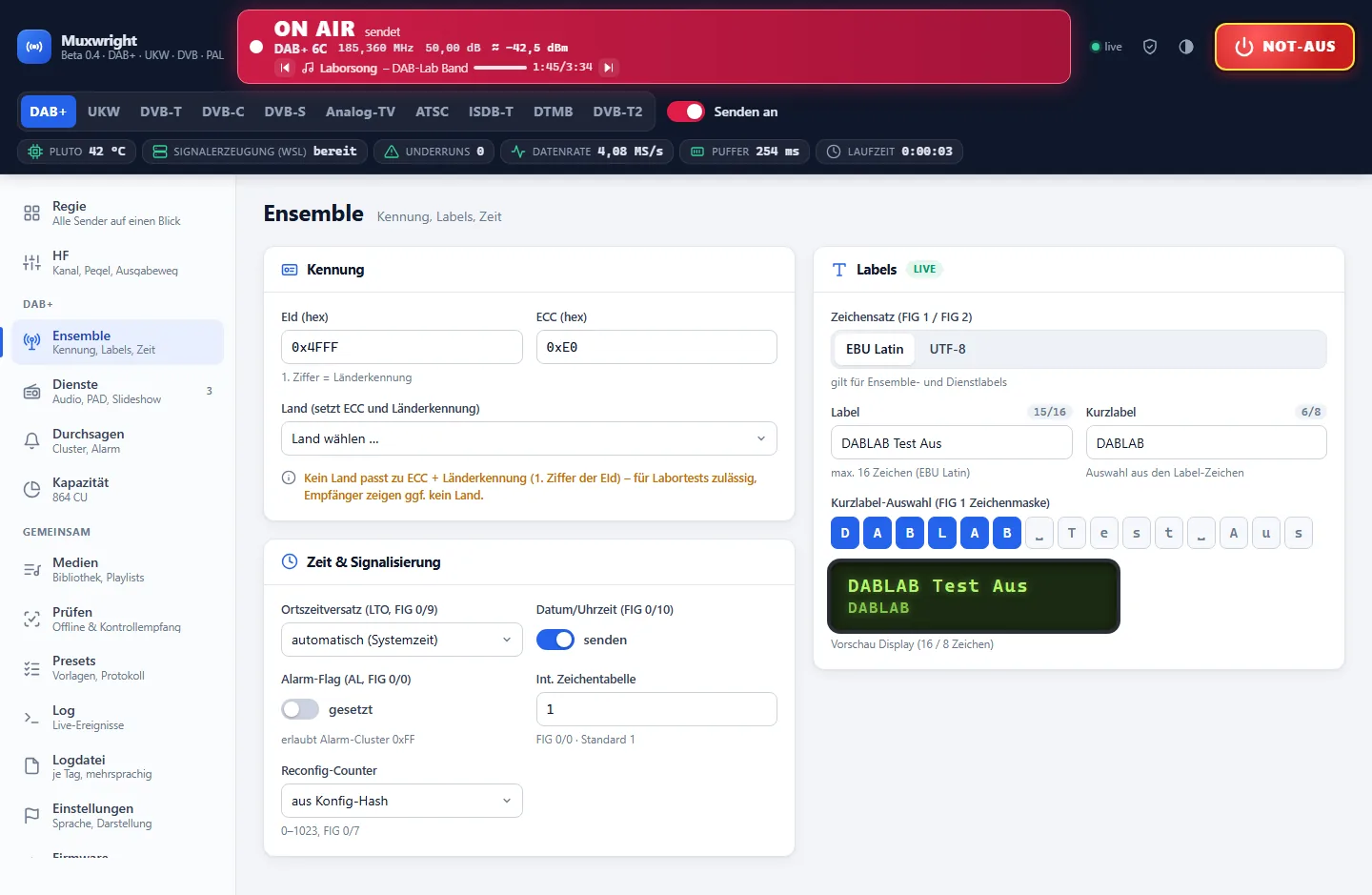
Digital radio to ETSI EN 300 401
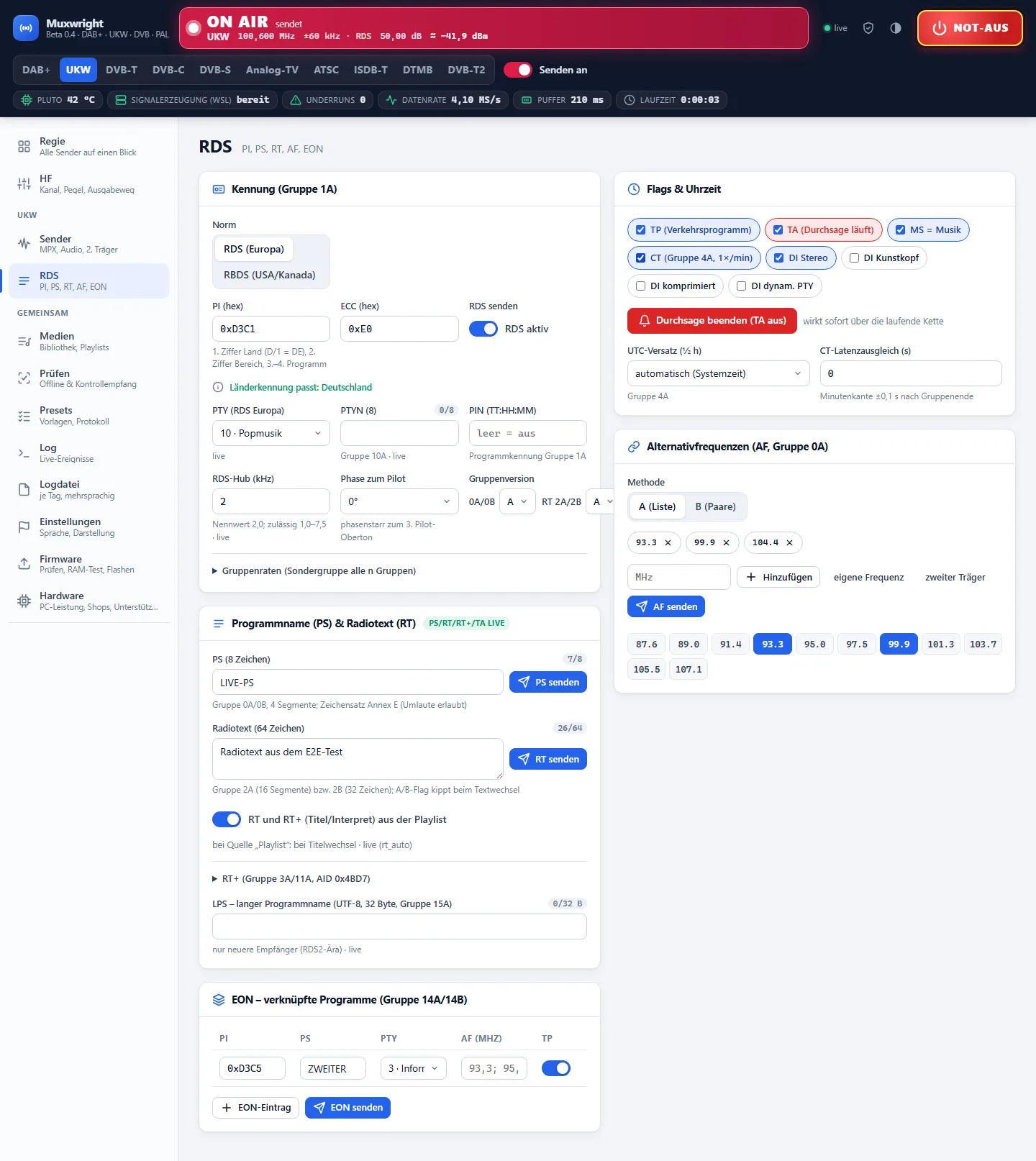
87.5–108 MHz, 19 kHz pilot, 50/75 µs pre-emphasis
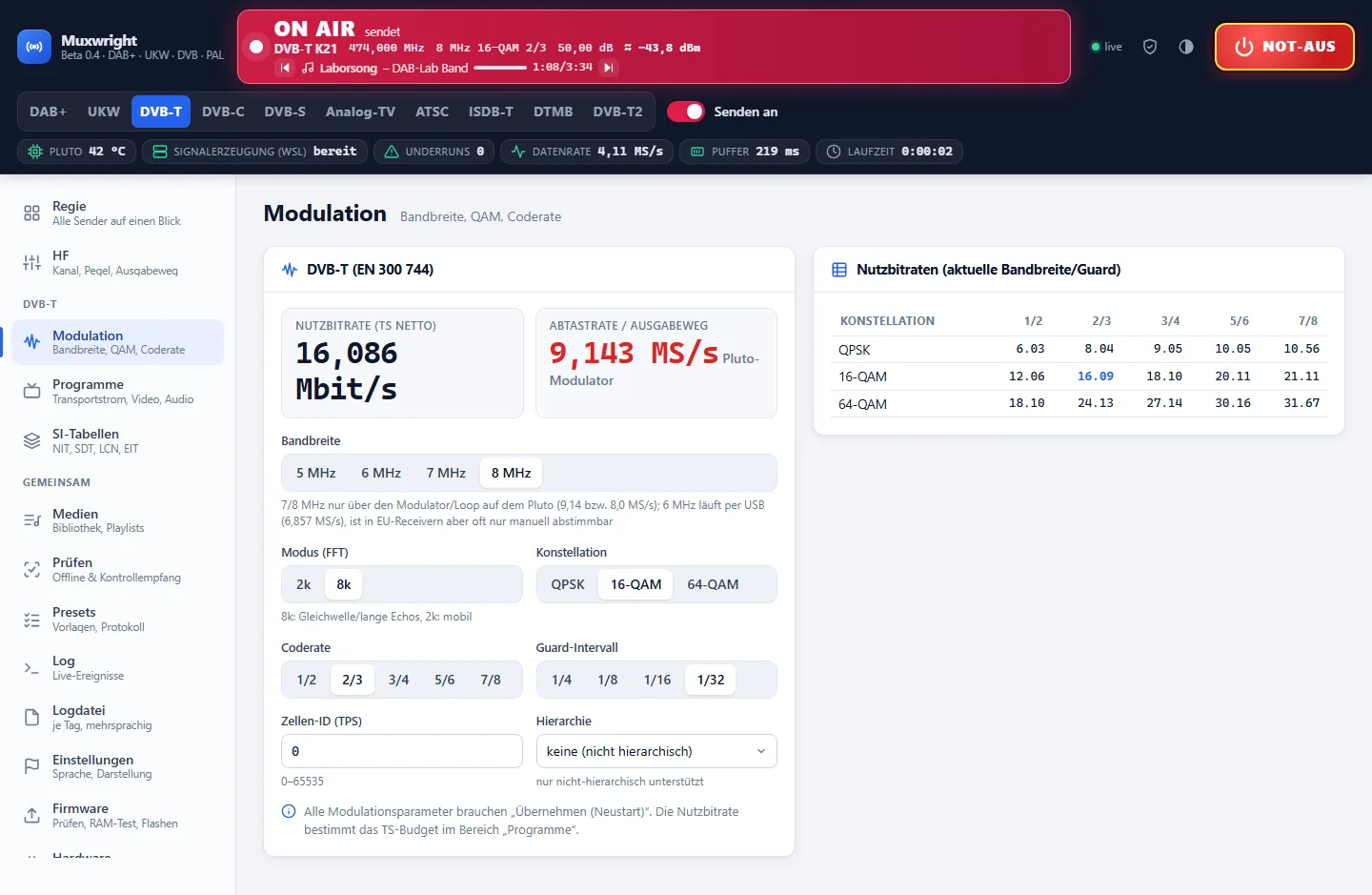
ETSI EN 300 744, 8 MHz in real time on the Pluto
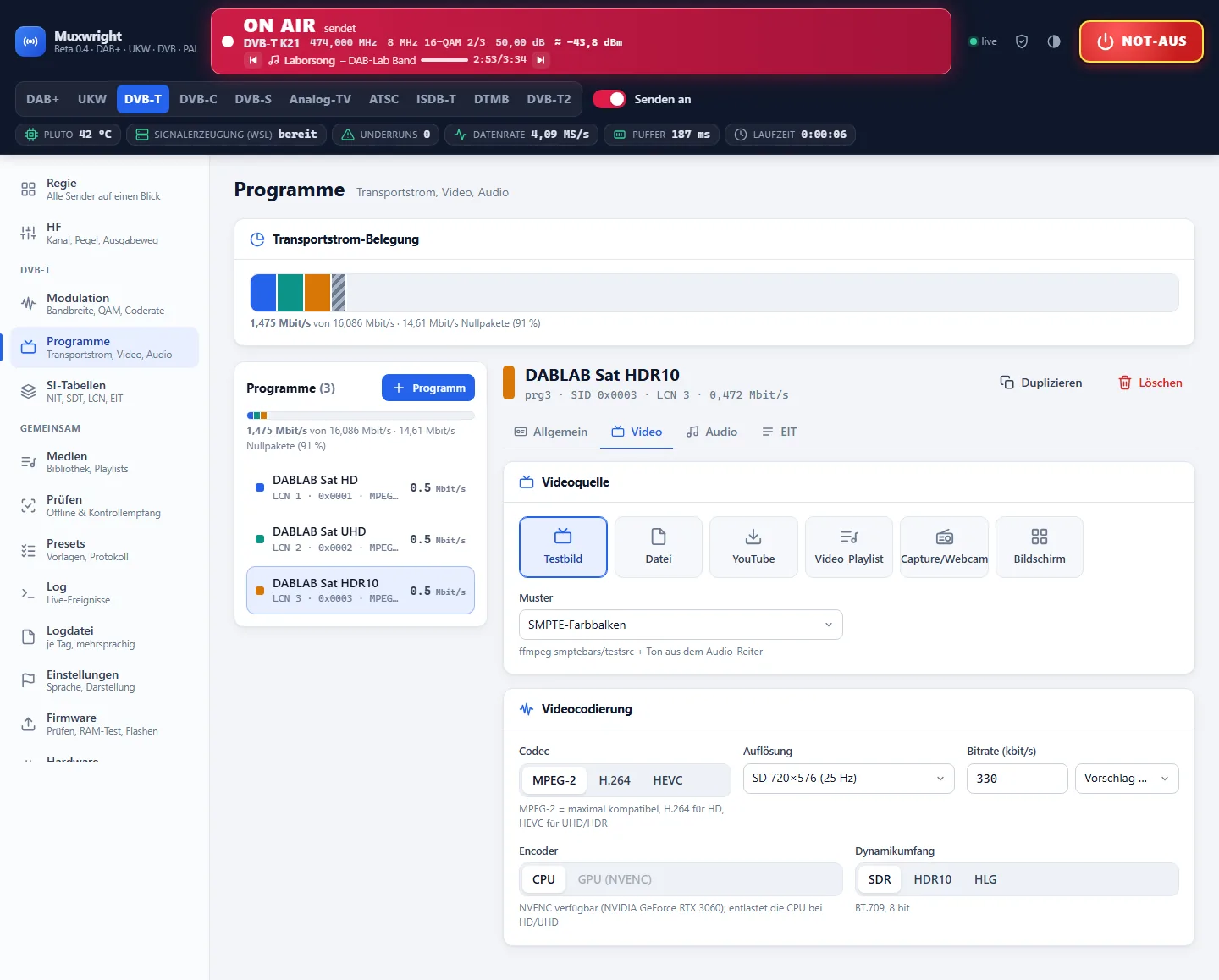
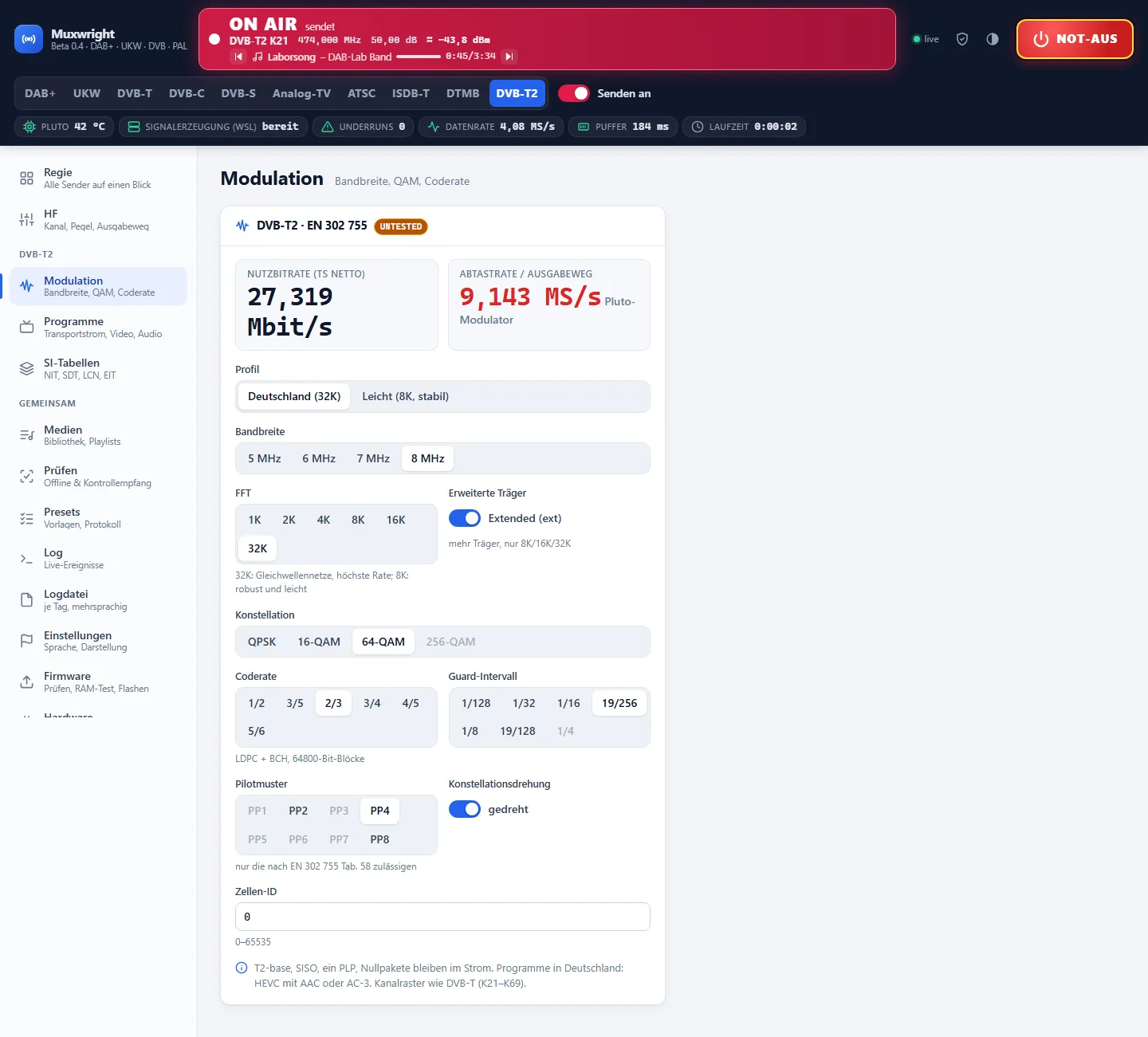
ETSI EN 302 755, Germany profile in real time on the Pluto
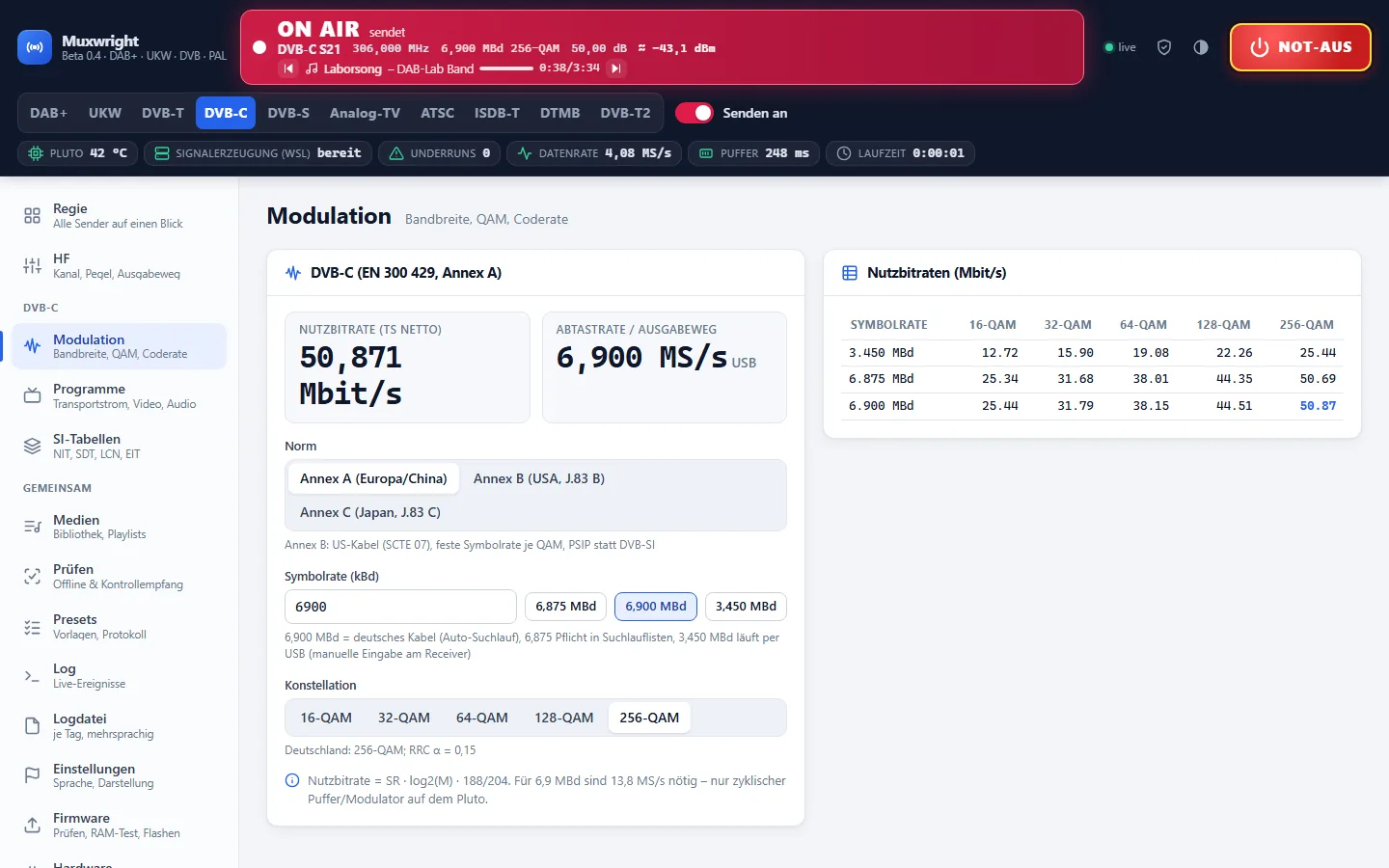
ETSI EN 300 429 (J.83 Annex A), J.83 B and C
ETSI EN 300 421 and EN 302 307 (DVB-S2)
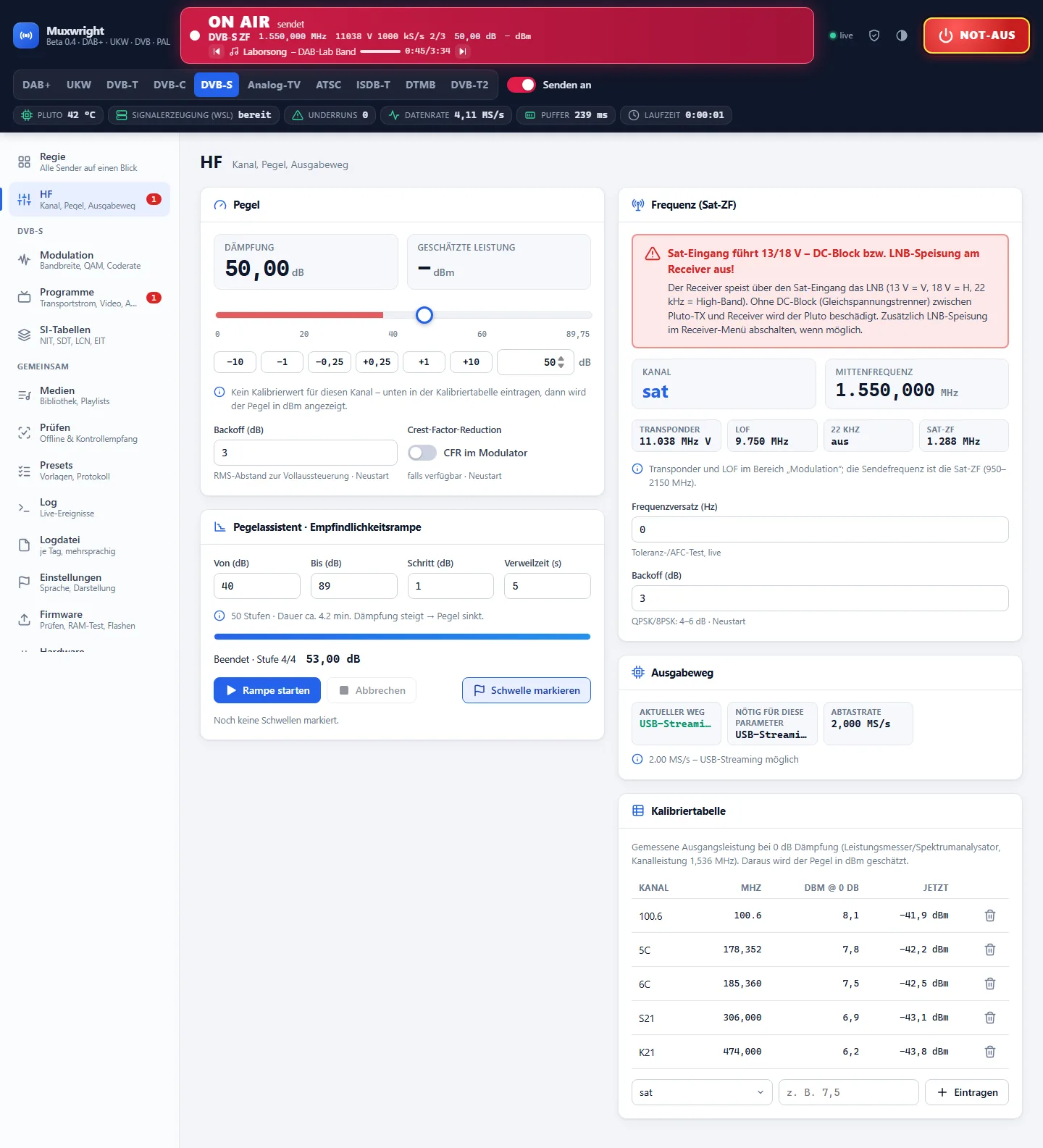
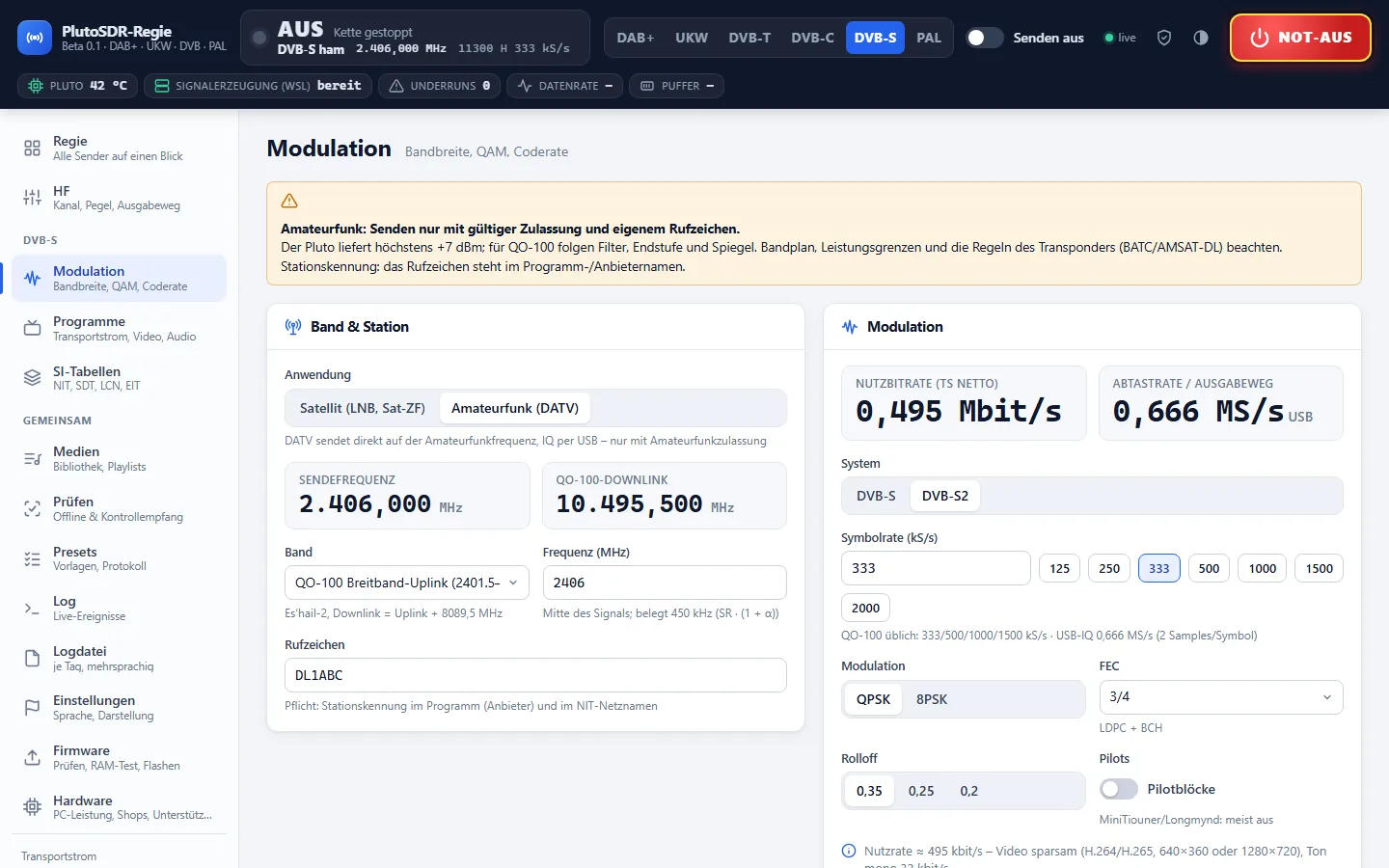
DVB-S2 on QO-100 and the amateur bands
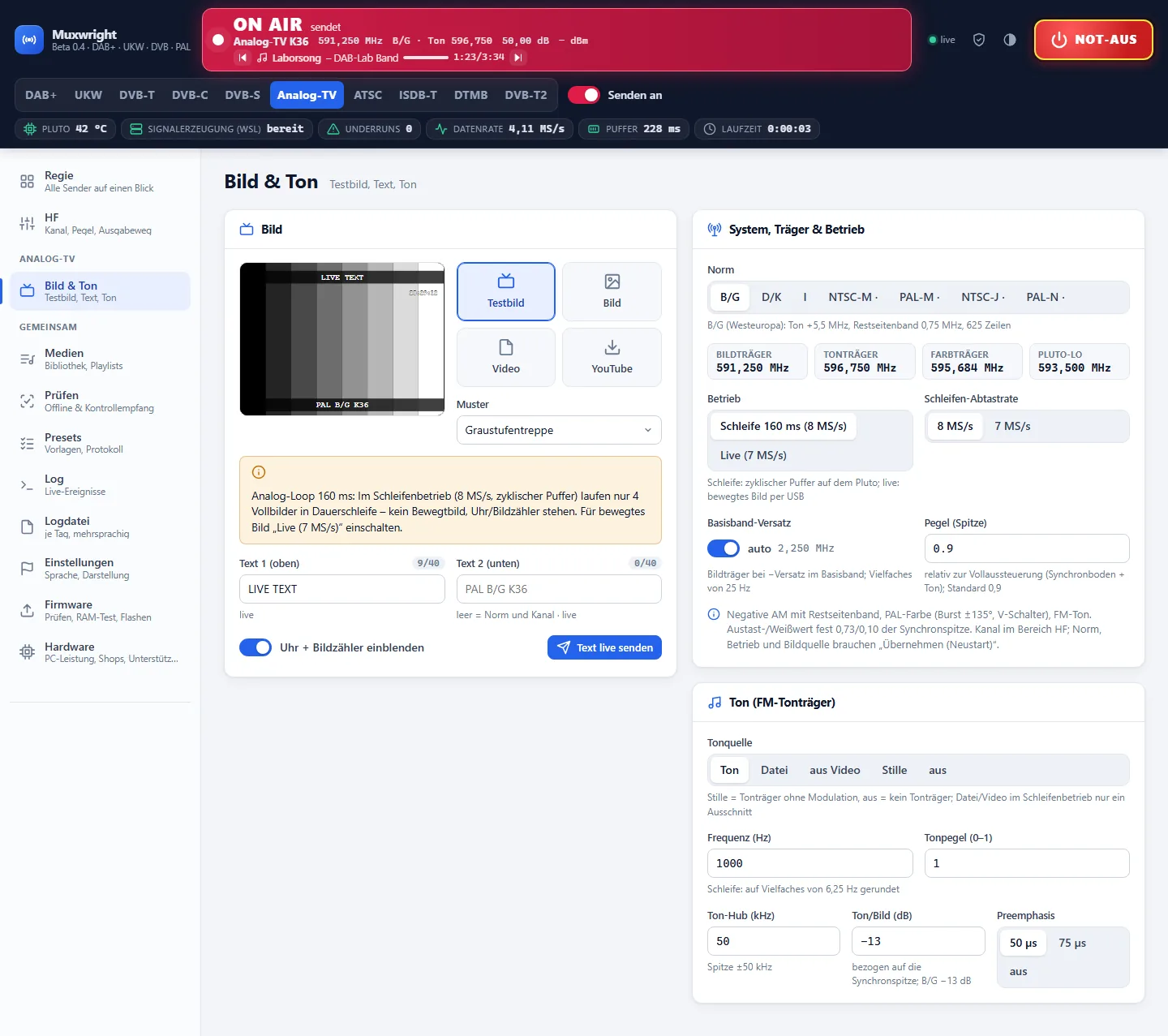
PAL B/G, D/K, I, M, N and NTSC-M/J with FM sound
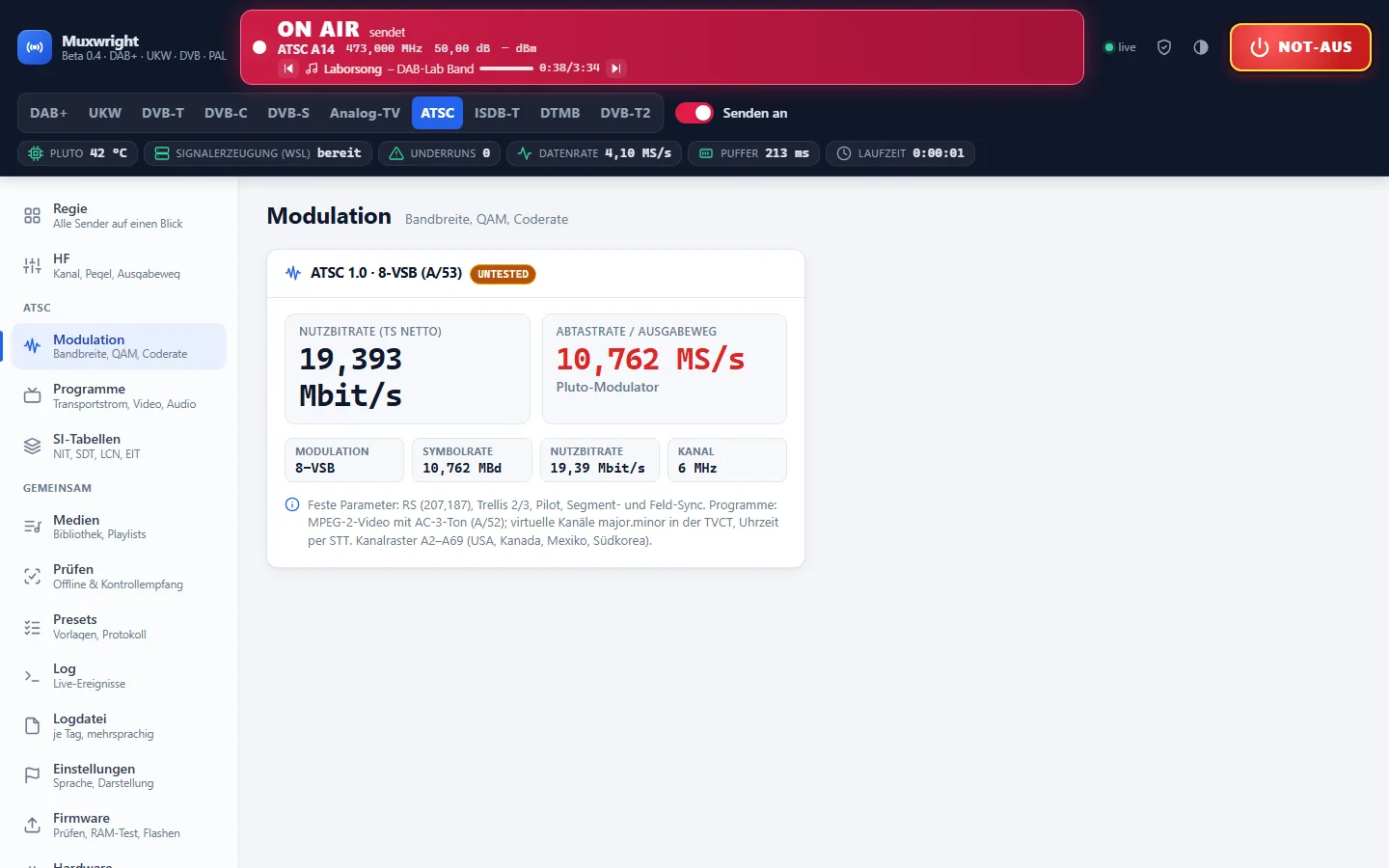
ATSC A/53, 8-VSB for North America
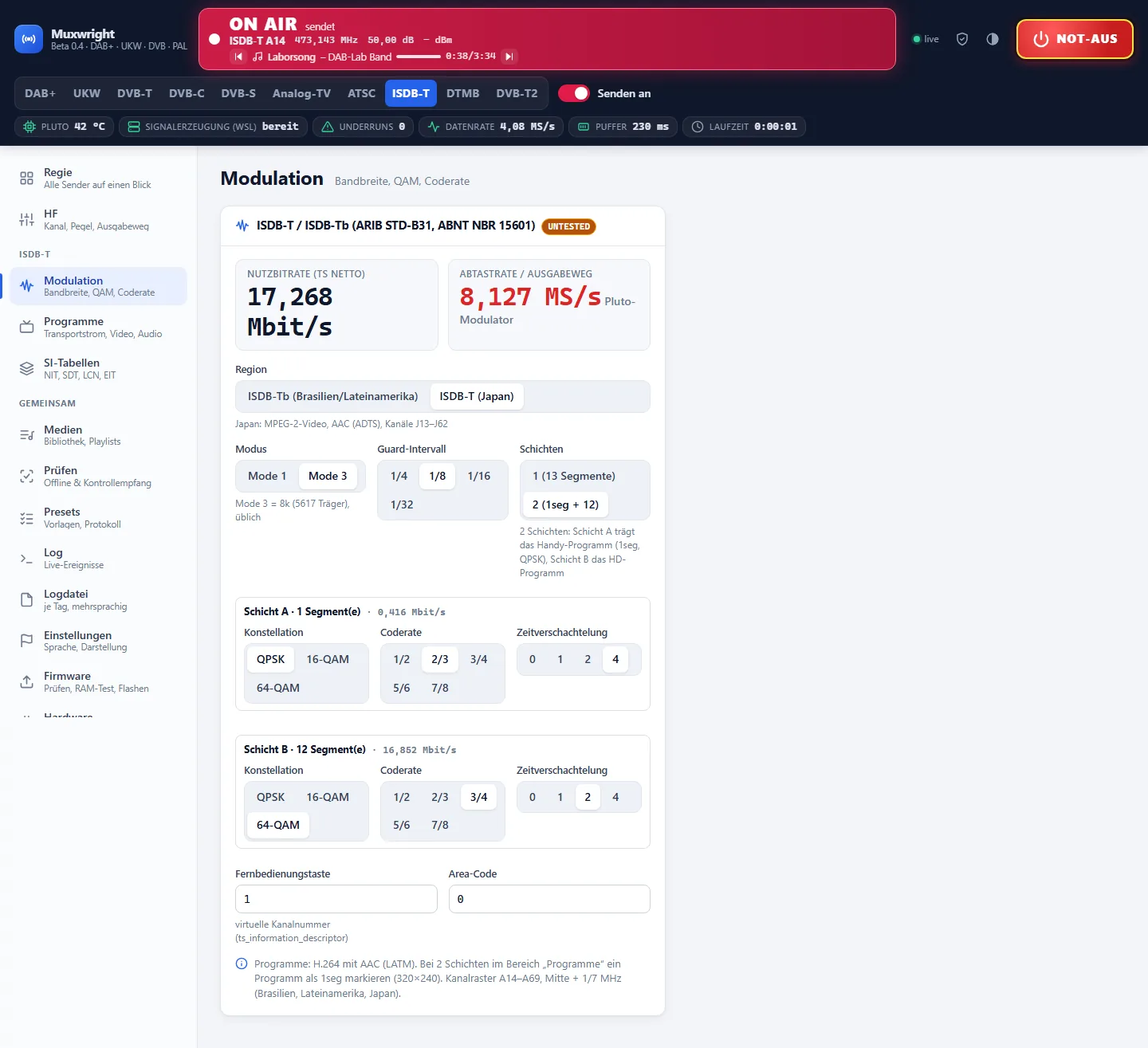
ARIB STD-B31 and ABNT NBR 15601 for Japan and Latin America
GB 20600 for China
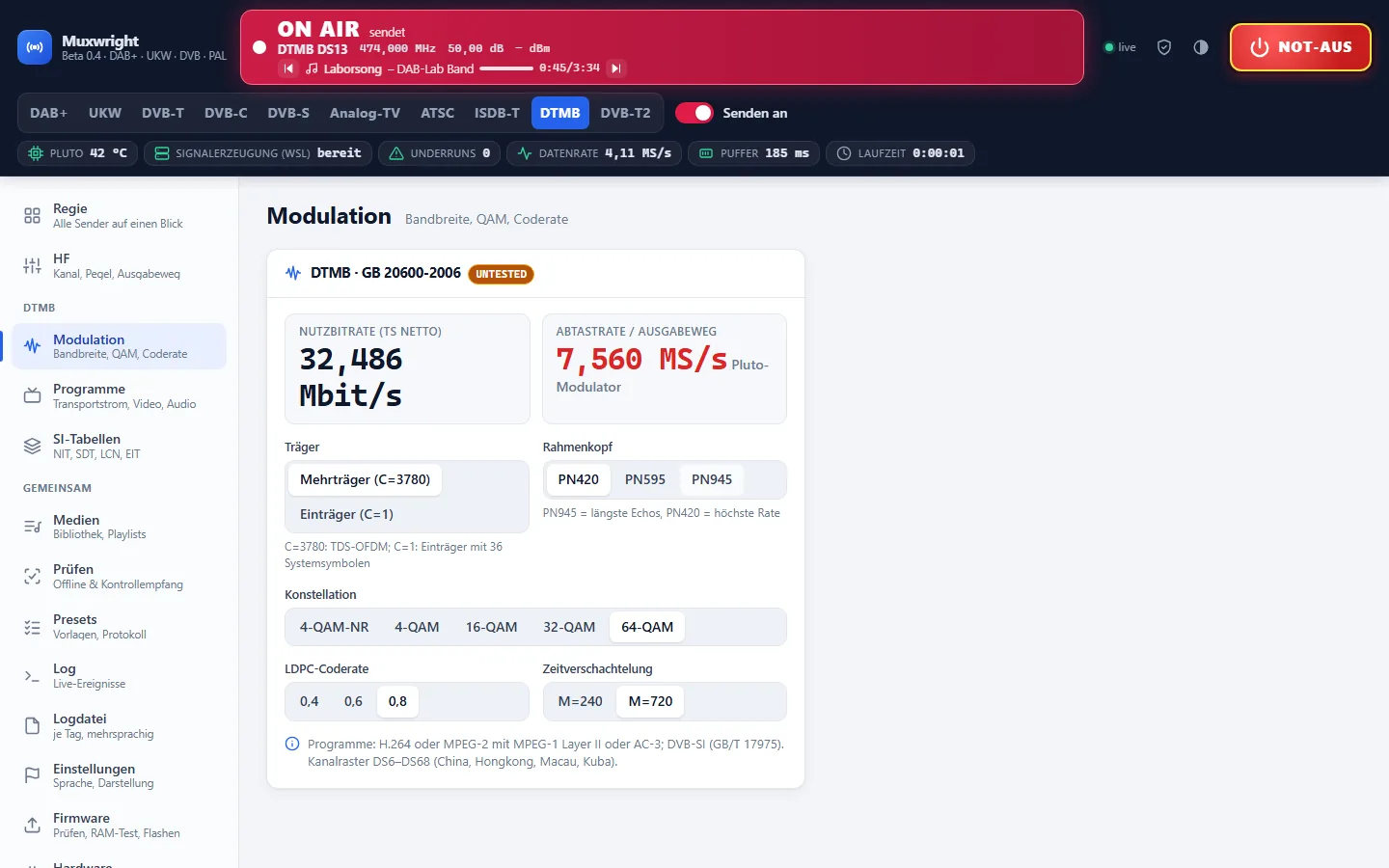
Runs in the browser, light and dark, also on a phone. Works offline, no cloud.
Setup without admin rights. One double-click starts server and dashboard. Close the window = transmitter off, Pluto muted.
In 20 languages: check device and firmware, rate PC performance, choose the operating mode, install components from the official sources.
Verifies the image, tests it in RAM first, backs up the running firmware and flashes only after confirmation.
The Pluto's own RX input receives and decodes the signal: sync, SNR, services, text.
Every configuration is rendered and decoded. Deviations are listed line by line.
Templates for recurring tests, level ramps and channel changes.
Print-ready record with timestamps, parameters and results, e.g. for certification.
System requirements
| Use case | CPU minimum | CPU recommended | NVIDIA NVENC minimum | NVIDIA NVENC recommended | RAM minimum / recommended |
|---|---|---|---|---|---|
| DAB+ / FM-RDSaudio | Any current PC. Audio encoders need very little computing power; no graphics card required. | 8 / 16 GB | |||
| SD MPEG-2DVB-T/C/S, 576i | any 2-core CPU | 4 cores / 8 threads | – (NVENC has no MPEG-2) | – | 8 / 16 GB |
| HD 1080p25 H.264DVB-T/C/S | 4 cores / 8 threads, x264 veryfast estimate | 6 cores / 12 threads from 2021, e.g. Core i5-12400 (x264 medium ≈ 100 fps) or Ryzen 5 7600 (≈ 135 fps) | Maxwell 1 (GTX 750 Ti) | Turing or newer (GTX 1660 / RTX 2060+) | 8 / 16 GB |
| UHD 2160p25 HEVC8-bit, DVB-S2 | 8 cores / 16 threads, x265 superfast estimate | 16 cores, e.g. Ryzen 9 9950X (x265 medium ≈ 40 fps) or Core Ultra 9 285K. For comparison: i5-12400 ≈ 15.5 fps, Ryzen 5 7600 ≈ 17.5 fps | Maxwell 2 (GTX 960) | Turing or newer (RTX 20/30/40) | 16 / 32 GB estimate |
| UHD HDR10HEVC Main10, DVB-S2 | 16 cores or more, fast x265 presets estimate | 16+ cores; an NVENC card is usually the better choice here | Pascal (GTX 1050–1080) | RTX 20xx or newer; Ada/Blackwell (RTX 40/50) for headroom | 16 / 32 GB estimate |
| DATV H.264/H.265amateur radio, low resolution | 4 cores / 8 threads | 4 cores / 8 threads are usually enough | Maxwell 1 (H.264) / Maxwell 2 (H.265) | Turing or newer (HEVC with B-frames) | 8 / 16 GB |
| 2–3 programmes at onceone multiplex | HD only: 8 cores / 16 threads | 8 cores / 16 threads or more for HD; UHD on the CPU is not realistic | any card that handles the codec in the rows above (up to 12 sessions) | RTX 4070 Ti+ / 5070 Ti+ (more NVENC units) for 3 × UHD with headroom | 16 / 32 GB estimate |
| Operating system | Windows 11 with WSL2. Virtualisation (Intel VT-x / AMD-V or SVM) must be enabled in the BIOS/UEFI. | ||||
Check first, then buy: if your PC meets the "minimum" column for what you want to transmit, you need nothing new. The biggest step is usually an NVENC graphics card for UHD/HDR10; more RAM only for UHD or several programmes.
These links lead to the accessories page; the product links there are affiliate links marked as ads.
Buy hardware
Muxwright needs an ADALM-Pluto (PlutoSDR). Adapters, cables, attenuators, gear for radio amateurs and PC hardware are on the “Accessories” page.
The original ADALM-PLUTO is also sold by Analog Devices distributors (no affiliate link).
Beta 0.4 · For Windows 10/11 (64-bit), 86 MB. We e-mail you the download link once you confirm that you will use Muxwright only in a shielded lab.
Questions, lab evaluations, collaboration or licensing? Get in touch.